

Precision manufacturing increasingly relies on injection molding to produce complex components for automotive, electronics, medical devices, and consumer products. As molds become more intricate, featuring multi-cavity designs, fine cooling channels, and micro-structured geometries, maintaining optimal cooling efficiency has emerged as a critical challenge. Over time, scale, corrosion, and polymer residues accumulate in water channels, reducing heat transfer, increasing cycle times, and compromising part quality. Traditional manual or chemical cleaning methods are labor-intensive, inconsistent, and often insufficient for complex molds. Consequently, mold water channel cleaning machines have gained prominence, offering automated, precise, and reliable solutions that meet the rising demand for high-quality production with minimal downtime.
Modern mold water channel cleaning machines employ a combination of high-pressure fluid jets, ultrasonic vibration, and controlled flow systems to remove deposits from intricate mold channels. High-pressure jets mechanically dislodge scale and polymer residues, while ultrasonic cavitation generates microscopic bubbles that penetrate narrow channels, ensuring comprehensive cleaning without damaging the mold surface. Programmable cycles allow operators to adjust pressure, flow rate, and duration to accommodate channel geometry and residue type. These technologies enable cleaning of multi-cavity molds, micro-channels, and branched cooling structures that would otherwise be inaccessible, ensuring uniform temperature control and improved production efficiency.
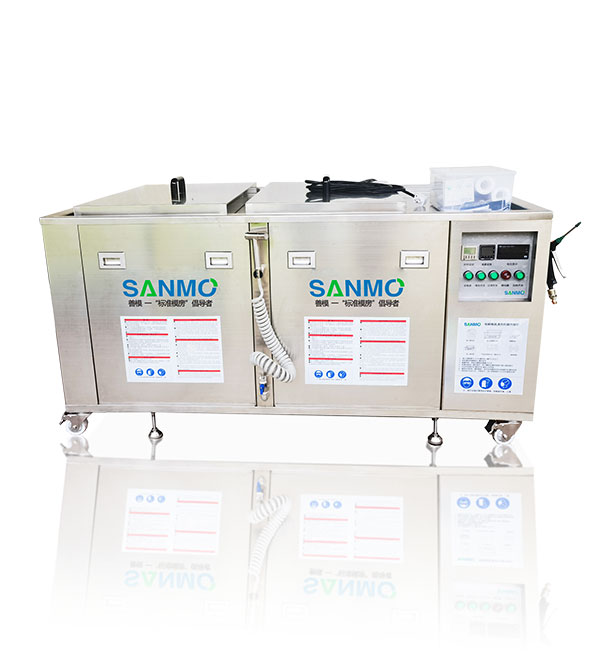
A typical mold water channel cleaning machine consists of a corrosion-resistant cleaning tank, high-pressure pump system, flow control valves, a control unit, and secure mold fixtures. Stainless steel or coated alloys are commonly used for tanks and pipelines to withstand continuous exposure to water, cleaning agents, or additives. Precision-engineered pumps deliver consistent pressure and flow, while the control unit allows programmable cleaning cycles tailored to specific mold designs. Fixtures secure molds during operation, ensuring uniform exposure to cleaning forces. Manufacturing tolerances for all components are critical; high-precision fabrication prevents leaks, maintains stable flow distribution, and guarantees repeatable cleaning results for complex molds.
Cleaning effectiveness depends on several variables. Channel diameter, length, and curvature influence the ability of fluid jets and ultrasonic waves to reach all surfaces. The nature of deposits—mineral scale, polymer residue, or rust—dictates required cleaning pressure and cycle duration. Water quality, temperature, and flow rate also impact the chemical and mechanical cleaning effects. Improper parameter selection can leave residues, damage mold surfaces, or reduce operational efficiency. Careful calibration and monitoring ensure that cleaning achieves thorough results while preserving mold integrity and extending service life.
Selecting a reliable supplier is essential for manufacturers seeking consistent cleaning performance. Key criteria include equipment reliability, technical expertise in precision mold maintenance, local service and support networks, and availability of spare parts. Suppliers with experience handling complex molds across automotive, electronics, and medical industries can provide customized solutions and ensure compatibility with intricate channel designs. Additionally, vendors offering training, detailed manuals, and software support facilitate smoother integration into preventive maintenance programs, minimizing production disruptions.
Despite technological advances, several challenges persist. Multi-cavity and branched cooling channels can restrict fluid flow, necessitating customized cleaning cycles or extended processing times. Excessive or uneven deposits may require repeated cleaning, impacting production schedules. Manual methods are often inconsistent, risking scratches or dimensional deviations. Scheduling maintenance without halting production remains a major concern. Advanced mold water channel cleaning machines address many of these issues but rely on skilled operation and precise calibration to achieve optimal results.
Mold water channel cleaning machines are widely applied in sectors demanding high-precision injection molding. In automotive manufacturing, they maintain molds for engine components, safety-critical plastic parts, and interior panels, ensuring uniform cycle times and consistent product quality. Electronics manufacturers employ these machines for connectors, housings, and intricate casings, preventing micro-defects caused by residue accumulation. Medical device production benefits from cleaning fine cavities in surgical instruments, diagnostic devices, and microfluidic components, meeting stringent quality and hygiene standards. Across these applications, improved cooling channel cleanliness directly translates to reduced scrap rates, longer mold life, and increased operational efficiency.
The industry trend is toward increased automation, integration with smart manufacturing, and environmentally sustainable designs. Modern machines feature programmable cleaning cycles, sensor feedback, and real-time data logging to track mold condition and optimize maintenance schedules. Ultrasonic-assisted cleaning continues to advance, offering more effective residue removal for increasingly complex molds. Closed-loop water and cleaning solution systems reduce resource consumption and environmental impact. As molds become more sophisticated and production demands grow, adoption of advanced mold water channel cleaning technology is expected to expand, supporting higher efficiency, reduced defects, and sustainable manufacturing practices.
Q1: Can these machines clean all types of complex molds?
Yes, modern machines accommodate multi-cavity molds, micro-channels, and branched structures, with adjustable cycles for varying geometries.
Q2: How often should cooling channels be cleaned?
Cleaning frequency depends on production volume, material type, and channel design. Preventive maintenance ensures optimal thermal performance.
Q3: Can the cleaning process damage delicate mold surfaces?
When properly operated, high-pressure and ultrasonic cleaning remove residues without mechanical abrasion, preserving mold precision.
Q4: What types of deposits can be removed?
Scale, rust, polymer residues, and other deposits that obstruct coolant flow can be efficiently removed.
@2024 Shanmo Precision Machinery (Kunshan) Co., Ltd. All rights reserved. Mold waterway cleaning machine,
electrolytic mold cleaning machine, mold cleaning machine manufacturer
TEL:+86 512-55001520
whats app:+86 15599099006 / +86 15599099098
E-Mail:sanmo030788@gmail.com
Add:No. 56, Yangjiaqiao Road, Zhoushi Town, Kunshan City Jiangsu Province


This website uses cookies to ensure you get the best experience on our website.
 Español
 Pусский
 العربية
 Tiếng Việt



 Your phone
 E-mail
Comment
(0)