

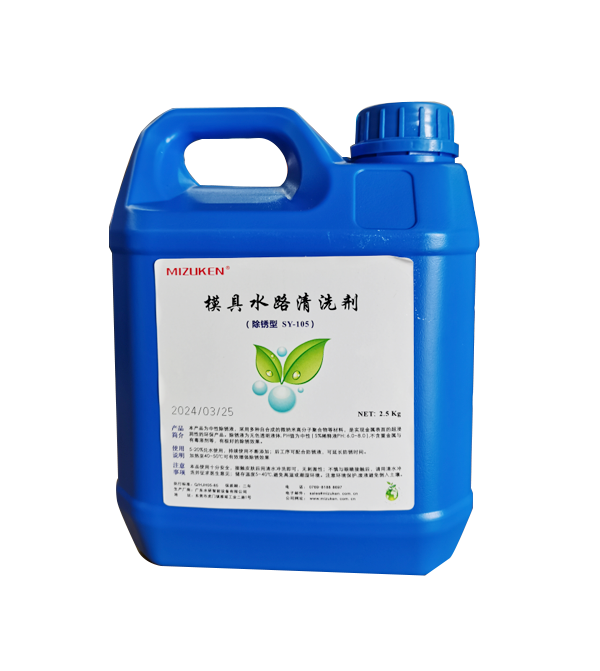
SY-105 Nano Neutral Rust Remover
Appearance (undiluted): Transparent liquid
Density: 1.05 ± 0.05
pH Value: 5% diluted solution pH 6.0~8.0
Safety Check: Non-toxic, harmless, and non-irritating.
Corrosion and surface oxidation remain persistent challenges across industrial sectors including manufacturing, automotive, aerospace, and precision tooling. Traditional rust removal methods, such as mechanical abrasion or strong acidic treatments, often compromise the integrity of metal components and introduce downtime in production lines. With global emphasis on minimizing maintenance costs and extending equipment lifespan, there is an increasing demand for chemical solutions that remove rust effectively while preserving surface quality. The SY‑105 Nano Neutral Rust Remover addresses these needs by combining advanced chemistry with nano‑enhanced penetration to clean ferrous metals efficiently without aggressive reagents.
Rust, primarily composed of iron oxides, forms when ferrous metals are exposed to moisture and oxygen. Effective removal requires breaking the oxide bond without attacking the underlying metal. SY‑105 utilizes a neutral pH formulation that incorporates nano‑scale chelating agents. These nanoparticles penetrate micro‑crevices and pores, targeting rust deposits at a microscopic level while minimizing surface etching. Unlike traditional acidic treatments, the neutral approach reduces the risk of corrosion during the cleaning process. The synergy of nano‑enhanced penetration and mild chemical reactivity ensures uniform rust removal on complex geometries, including molds, dies, and thin-walled components.
SY‑105 is supplied as a concentrated liquid solution. Its core components include:
Nano chelating agents: Facilitate deep penetration into rust layers and maintain metal ion solubility to prevent re‑precipitation.
Stabilizers and corrosion inhibitors: Protect base metals during treatment, ensuring minimal surface alteration.
Surfactants: Enhance wetting, allowing the solution to reach hidden or irregular surfaces.
Buffer systems: Maintain neutral pH for safe handling and broad metal compatibility.
Manufacturing involves precise blending under controlled temperature and pH conditions to ensure uniform nanoparticle distribution and consistent activity. High-purity raw materials reduce contamination risks, essential for precision and tooling applications.
Performance indicators include rust removal efficiency, compatibility with different alloys, and maintenance of surface finish post-treatment. SY‑105 demonstrates rapid action on moderate rust layers while remaining safe for repeated use on delicate or high-value components.
Several parameters affect the efficiency of SY‑105 applications:
Metal type: Stainless steel, carbon steel, and aluminum alloys each respond differently; inhibitors and treatment time may require adjustment.
Rust composition: Mixed oxides or thick scale may need multiple applications or extended contact time.
Temperature and circulation: Moderate heating and proper fluid flow improve penetration and reaction kinetics.
Surface geometry: Internal channels, threaded surfaces, or microstructures demand careful agitation or circulation to ensure complete cleaning.
Monitoring these factors ensures optimal results without compromising component integrity.
Industrial buyers must consider multiple criteria when sourcing rust removal chemicals:
Technical documentation: Comprehensive datasheets, handling instructions, and compatibility guidelines.
Regulatory compliance: Adherence to REACH, OSHA, and local transport regulations.
Quality assurance: ISO-certified production processes to guarantee batch consistency.
Support and service: Access to technical guidance, pilot testing, and dosing recommendations.
Sustainability: Preference for formulations with lower environmental impact and manageable waste disposal.
A reliable supply chain ensures uninterrupted maintenance schedules and long-term equipment protection.
Rust removal often faces several operational challenges:
Incomplete penetration in complex structures leads to residual corrosion and uneven surfaces.
Overexposure risks: Prolonged contact with aggressive agents can damage sensitive alloys.
Waste management: Rust-laden solutions require proper neutralization and disposal.
Downtime impact: Chemical cleaning processes must be coordinated with production schedules to minimize lost output.
SY‑105 mitigates many of these issues by providing a neutral, nano‑enhanced solution with predictable performance.
Injection Molding: Cooling channels in molds accumulate rust over time. Circulating SY‑105 restores flow efficiency and stabilizes thermal performance, reducing scrap rates.
Tooling and Dies: Rust on precision dies can affect tolerances and surface finish. Nano penetration ensures thorough cleaning without micro-etching.
Industrial Machinery: Bearings, shafts, and other ferrous components benefit from periodic treatment, preventing corrosion-induced failures and extending operational life.
Emerging trends in rust removal include:
Nano‑enhanced chemistries: Increasingly used for deep penetration into micro-structures.
Low-temperature formulations: Reduce energy consumption while maintaining cleaning performance.
Real-time monitoring: Sensors and automated dosing improve efficiency and reduce chemical waste.
Sustainable maintenance: Development of biodegradable and low-toxicity inhibitors aligns with environmental regulations.
These trends indicate a shift toward safer, more efficient, and environmentally conscious rust removal strategies in industrial maintenance.
Q1: Can SY‑105 be used on all ferrous metals?
It is compatible with most ferrous metals, including stainless steel and carbon steel. Compatibility testing is recommended for specialized alloys.
Q2: Is heat required for effective rust removal?
Moderate temperatures can accelerate reaction rates, but SY‑105 is effective at room temperature for most applications.
Q3: How should spent solution be disposed of?
Waste should be neutralized according to local regulations and disposed of through approved chemical waste channels.
@2024 Shanmo Precision Machinery (Kunshan) Co., Ltd. All rights reserved. Mold waterway cleaning machine,
electrolytic mold cleaning machine, mold cleaning machine manufacturer
TEL:+86 512-55001520
whats app:+86 15599099006 / +86 15599099098
E-Mail:sanmo030788@gmail.com
Add:No. 56, Yangjiaqiao Road, Zhoushi Town, Kunshan City Jiangsu Province


This website uses cookies to ensure you get the best experience on our website.
 Español
 Pусский
 العربية
 Tiếng Việt



 Your phone
 E-mail