

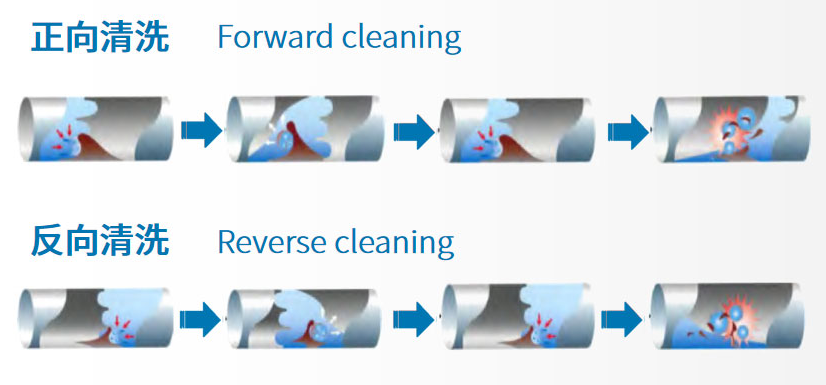
The Shanmo Mold water cleaning machine utilizes patented technology. A pulse controller directs compressed air in pulses onto the water flow, generating a spiral shearing force along the inner wall of the pipe and frequently inducing cavitation.
Under alternating pressure, water bubbles burst, generating micro-jet and shock wave impacts. These jets exert a powerful impact on solid surfaces, causing localized surface damage. The jets and the waves generated by bursting bubbles act on the solid surface at high speed and pressure, eroding and removing scale and brittle fragments, effectively cleaning the inner wall of the pipe.
Working Principle of the Mold Water Cleaning Machine
The Shanmo mold water cleaning machine utilizes patented technology. A pulse controller directs compressed air in pulses onto the water flow, generating a spiral shearing force along the inner wall of the pipe and frequently inducing cavitation.
Under alternating pressure, water causes bubbles to burst, generating micro-jet impacts and shock wave impacts. These jets can exert a huge impact on the solid surface and cause local surface damage. The jets and the waves generated by the bursting bubbles act on the solid surface at high speed and high pressure, eroding it, removing scale and brittle fragments, and effectively cleaning the inner wall of the pipe.
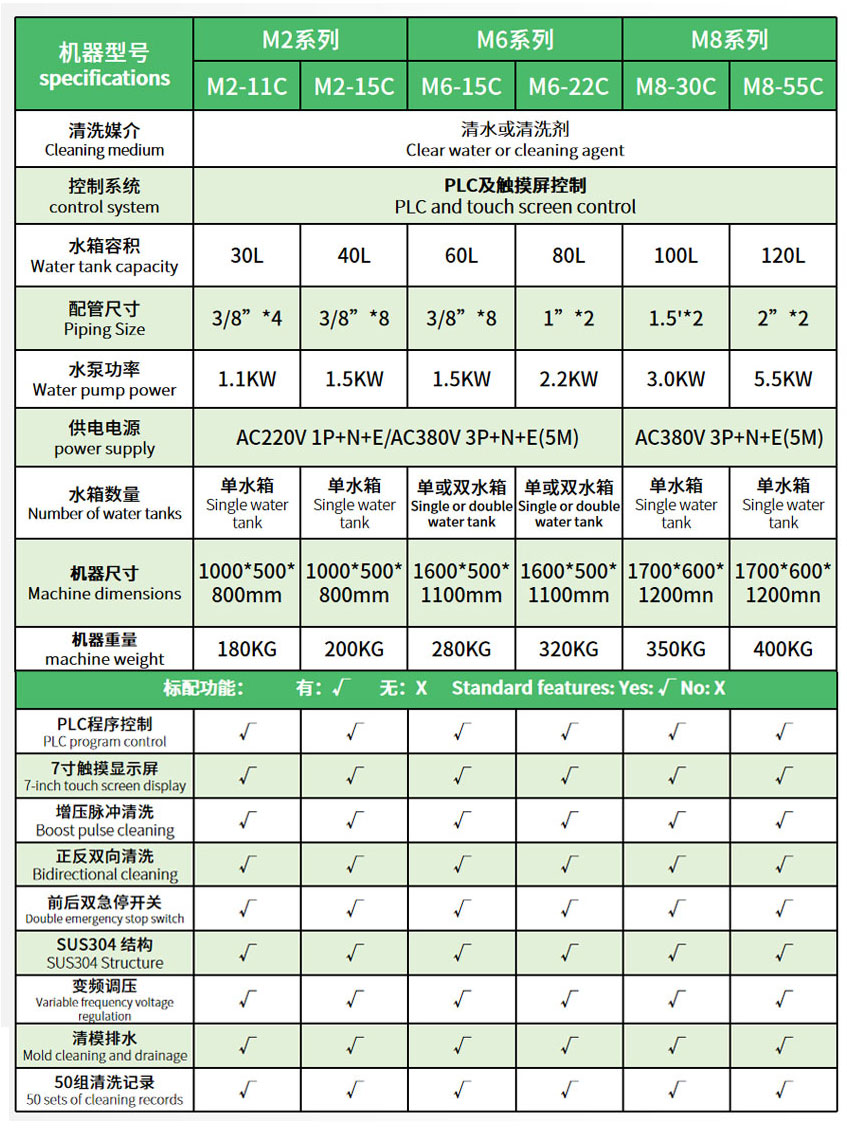
Product Model
A Mold water channel cleaning machine is a device used for cleaning the water channels of molds, commonly used in industries such as automotive manufacturing and home appliance manufacturing. The working principle of a mold water channel cleaning machine is to use high-pressure water jets to clean dirt and impurities from the mold, ensuring its usability.
A mold water channel cleaning machine typically consists of a main machine, a water channel system, a control system, and nozzles. The main machine is the core component, responsible for providing the cleaning water pressure and flow rate, driving the entire cleaning process. The water channel system refers to the piping system connecting the main machine and the mold water channels, delivering high-pressure water to the mold water channels. The control system controls the start-up, shutdown, and operation of the cleaning machine, ensuring smooth cleaning. The nozzles are a key component of the cleaning machine, cleaning the mold by spraying high-pressure water jets.
The working process of a mold water channel cleaning machine generally involves the following steps: First, preparation, including placing the mold inside the cleaning machine, connecting the water channel system and power supply, and setting the cleaning parameters. Next, the cleaning machine is started, with the control system activating the main machine and controlling the nozzles to spray high-pressure water jets. Next comes the cleaning process, where high-pressure water jets flush the mold's water channels, removing dirt and impurities. Finally, the work is finished; the cleaning machine is turned off, and the mold is removed for inspection.
The advantages of a mold water channel cleaning machine include excellent cleaning effect, high efficiency, and simple and convenient operation. It can quickly clean dirt from the mold's water channels, improving mold lifespan and production efficiency, while reducing maintenance costs and time. Furthermore, the mold water channel cleaning machine is energy-saving and environmentally friendly, using water as the cleaning medium and producing no waste gas or waste liquid, meeting environmental protection requirements.
In summary, the mold water channel cleaning machine is a highly effective mold cleaning device with significant application value for industries requiring mold water channel cleaning. With the development of manufacturing and the increasing demand for molds, mold water channel cleaning machines will receive increasing attention and become an indispensable cleaning equipment in the manufacturing industry.
In injection molding, die casting, and high-precision tooling industries, mold cooling efficiency is a decisive factor for cycle time stability and product quality. As production volumes increase and molds operate continuously, cooling water channels inevitably accumulate scale, corrosion products, and biological residues. These deposits reduce heat transfer efficiency, create uneven temperature distribution, and increase scrap rates. Traditional manual cleaning methods are labor-intensive, inconsistent, and often require extended downtime. As a result, demand for Automated mold water cleaner systems has grown steadily, particularly in automotive, electronics, and medical manufacturing sectors where thermal control tolerance is narrow and uptime is critical.

An automated mold water cleaner is designed to clean internal cooling circuits without dismantling the mold. The core principle combines controlled fluid circulation with chemical or electrochemical cleaning mechanisms. By maintaining precise flow rates, temperature, and cleaning agent concentration, the system dissolves scale and rust while minimizing impact on base materials. Advanced units integrate sensors for conductivity, pH, and flow resistance, enabling closed-loop process control. Automation ensures repeatable results across multiple molds and reduces reliance on operator experience.
A typical automated mold water cleaner consists of a circulation pump, filtration unit, heat control module, chemical dosing system, and programmable control interface. Components in contact with cleaning fluids are commonly manufactured from corrosion-resistant stainless steel or engineered polymers. Performance is evaluated based on cleaning efficiency, flow stability, and compatibility with different mold materials such as tool steel, aluminum alloys, and copper inserts. Manufacturing processes emphasize leak-free assembly, chemical resistance testing, and electrical safety compliance to meet industrial standards in European and North American markets.
Several variables influence the effectiveness of an automated mold water cleaner. Deposit composition is a primary factor; calcium-based scale requires different treatment than iron oxide corrosion. Channel geometry also plays a role, as long or narrow circuits demand stable pressure control to avoid dead zones. Incorrect cleaning agent selection or excessive concentration can damage mold surfaces, while insufficient circulation may leave residues behind. Equipment calibration, sensor accuracy, and operator-defined parameters directly impact cleaning consistency and overall mold lifespan.
Choosing a reliable supplier involves more than evaluating equipment specifications. Buyers should assess the supplier’s understanding of mold cooling systems, availability of compatible cleaning agents, and after-sales technical support. Documentation quality, compliance with safety regulations, and availability of replacement parts are critical for long-term operation. For global manufacturers, localized service capability and stable supply chains reduce operational risk, especially when equipment is integrated into preventive maintenance programs.
One recurring challenge is the lack of visibility into internal cooling channel conditions. Many manufacturers only detect problems after cycle times increase or quality issues arise. Another pain point is inconsistent cleaning results from manual flushing or outsourced services. Over-cleaning can accelerate corrosion, while under-cleaning leaves performance issues unresolved. Automated mold water cleaner systems address these challenges by standardizing cleaning procedures and providing measurable process data.
In automotive injection molding, automated cleaning is often scheduled during planned maintenance to restore thermal balance across multi-cavity molds. Electronics manufacturers use these systems to maintain tight dimensional tolerances in high-speed molding operations. In medical device production, where contamination control is essential, automated cleaning supports validation requirements by delivering documented, repeatable results. Across industries, the technology enables predictive maintenance strategies rather than reactive repairs.
The market is moving toward smarter, data-driven cleaning solutions. Integration with factory maintenance systems allows automated mold water cleaner units to trigger cleaning cycles based on pressure drop or temperature deviation trends. Environmentally focused designs are also gaining attention, with reduced chemical consumption and closed-loop fluid management. Future developments are expected to include adaptive cleaning algorithms and broader compatibility with advanced mold materials and additive-manufactured cooling channels.
How often should mold water channels be cleaned?
Intervals depend on water quality and production intensity, but many facilities schedule automated cleaning every few months based on monitoring data.
Can automated systems replace manual cleaning entirely?
For internal cooling circuits, automated solutions significantly reduce the need for disassembly, though external mold surfaces still require routine inspection.
Is material damage a concern?
When properly configured, an automated mold water cleaner minimizes corrosion risk compared to uncontrolled manual methods.
Automated mold water cleaner technology plays a critical role in modern mold maintenance by improving thermal efficiency, reducing downtime, and supporting consistent product quality. As manufacturing environments become more automated and data-driven, these systems are increasingly viewed not as optional equipment, but as essential infrastructure for reliable, high-volume production.
@2024 Shanmo Precision Machinery (Kunshan) Co., Ltd. All rights reserved. Mold waterway cleaning machine,
electrolytic mold cleaning machine, mold cleaning machine manufacturer
TEL:+86 512-55001520
whats app:+86 15599099006 / +86 15599099098
E-Mail:sanmo030788@gmail.com
Add:No. 56, Yangjiaqiao Road, Zhoushi Town, Kunshan City Jiangsu Province


This website uses cookies to ensure you get the best experience on our website.
 Español
 Pусский
 العربية
 Tiếng Việt



 Your phone
 E-mail